
Business
Jet Card vs. Charter vs. Fractional Ownership: What’s the Difference?
Published: September 10, 2026
There is no single best way to fly privately.
On-demand charter, Jet Cards, and fractional ownership can all provide access to private aircraft, but they solve different problems. Charter purchases one trip at a time. A Jet Card prepays for future travel by hours or dollars under a set pricing and service model, with no aircraft to own. Fractional aircraft ownership involves acquiring an interest in an individual aircraft and participating in a managed fleet program.
As annual flight hours rise, the economics move from paying for access toward owning the asset, and the trade-off shifts from flexibility to control. The right choice depends on far more than your annual flight hours. Aircraft preferences, trip patterns, scheduling flexibility, budget restrictions, and appetite for a multiyear commitment can be just as important.
Private Jet Charter, Jet Card Programs, and Fractional Ownership each serve a different kind of traveler, and they differ in commitment, economics, and how much flexibility you retain. Here is how each works, and where each one fits.
On Demand Charter: The One Trip at a Time Approach
Private jet charter is the simplest entry point into private aviation. You request a trip, receive a quote for that specific itinerary, and pay for the flight. There is no membership, no prepaid balance, and no commitment beyond the trip itself.
Because each flight is priced independently, charter gives you the widest choice. Every quote can be matched to the trip at hand, whether that means a Light Jet for a short hop or a Heavy Jet for a transcontinental flight with a full passenger list.
What Charter Offers
- No upfront commitment: You pay per trip, with no deposit, block of hours, or multiyear agreement.
- Full aircraft choice: Each trip can be matched to the ideal cabin size and range, from Light Jets to Mid-Size, Super-Mid, and Heavy Jets.
- Flexibility for irregular travelers: Charter suits those who fly privately a few times a year or whose travel patterns are unpredictable.
- A way to try before committing: Many Jet Card holders and fractional owners started with charter to learn how they actually travel.
Charter Considerations
- Price variability: Quotes reflect market conditions, aircraft positioning, and demand at the time of booking. The same route can cost more or less on different dates.
- Availability during peak periods: Holidays and major events tighten the market, and short notice requests may have fewer options.
- Trip by trip effort: Without established terms, every flight involves a fresh quote and approval.
Charter is often the right answer for travelers who fly privately occasionally, or for anyone who wants to understand their own patterns before committing to a program. More information is available on the Jets.com Private Jet Charter page.
Jet Cards: The Pay-As-You-Go Approach
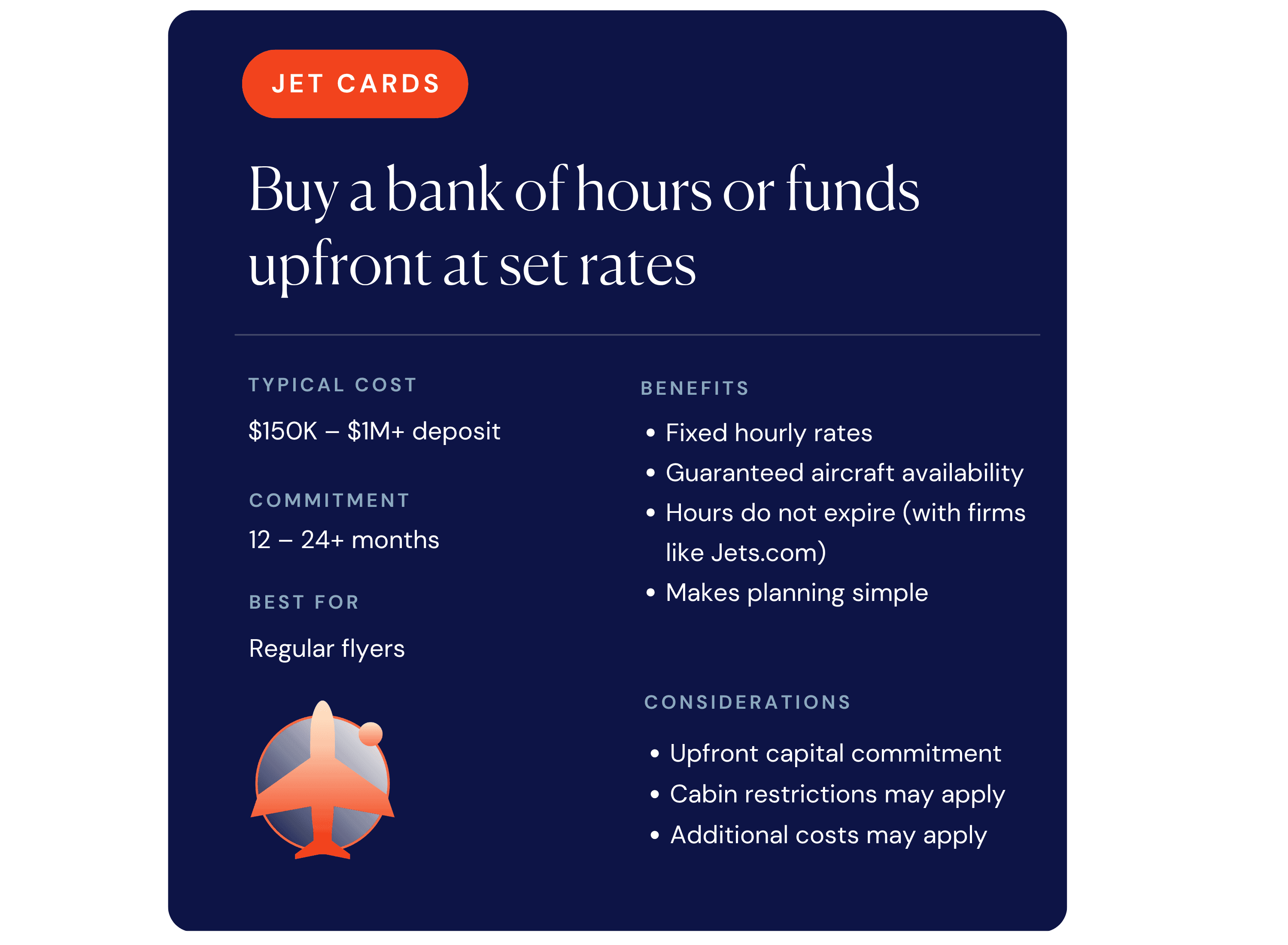
A Jet Card, also known as a private jet membership, offers a pay-as-you-go approach to private aviation. You typically purchase a block of flight hours or deposit funds, then book future trips based on the program’s rules and rates.
Jet Cards occupy the middle ground between on demand private jet charter and aircraft ownership. They can reduce some of the price and availability uncertainty of charter without the acquisition cost and multi-year obligations associated with fractional ownership.
What a Jet Card Offers
- Greater price predictability: Many programs establish hourly rates by cabin category, helping travelers estimate the cost of future trips more consistently.
- Set access standards: Jet Card agreements typically specify callout periods (advance booking time), service areas, Peak Day rules, and aircraft availability commitments.
- Aircraft-category flexibility: Jet Cards allow you to access a variety of private jet cabin sizes — from Light Jets to Mid, Super-Mid and Heavy Jets — without the long-term commitment of ownership. You can choose the right aircraft for each trip.
- Simplified booking: Pricing, trip support, and service expectations are established before each flight request, reducing the need to negotiate every trip from the beginning.
- No aircraft ownership: You receive private jet access without purchasing an asset or assuming responsibility for aircraft management.
Jet Card Considerations:
- Upfront costs: While Jet Cards don't require the capital outlay of fractional ownership, the initial purchase can still be substantial. Most programs require a minimum block of hours or a minimum deposit, so it helps to understand your likely annual usage before committing.
- Peak travel terms: Jet Card terms vary during high-demand periods. Some programs restrict or exclude travel on designated peak days. Others, including Jets.com, have no blackout dates, although longer advance-notice requirements and Peak Day rates may apply.
- No ownership perks: A Jet Card gives you access rather than equity in an aircraft. Jet Card holders do not participate in its residual value or receive ownership-related tax treatment that may be available to qualifying fractional owners.
A Jet Card can also complement aircraft ownership. For individuals or corporations that own a jet or have fractional ownership, you may still need a Jet Card if your primary aircraft is unavailable, doesn't go far enough, or hold enough passengers.
At Jets.com, our Access Plus and Access+ Jet Card programs offer all-inclusive fixed hourly rates, hours that do not expire, and year-round access without blackout dates. More information is available on the Jets.com Jet Card page.
Fractional Ownership: An Asset-Based Approach
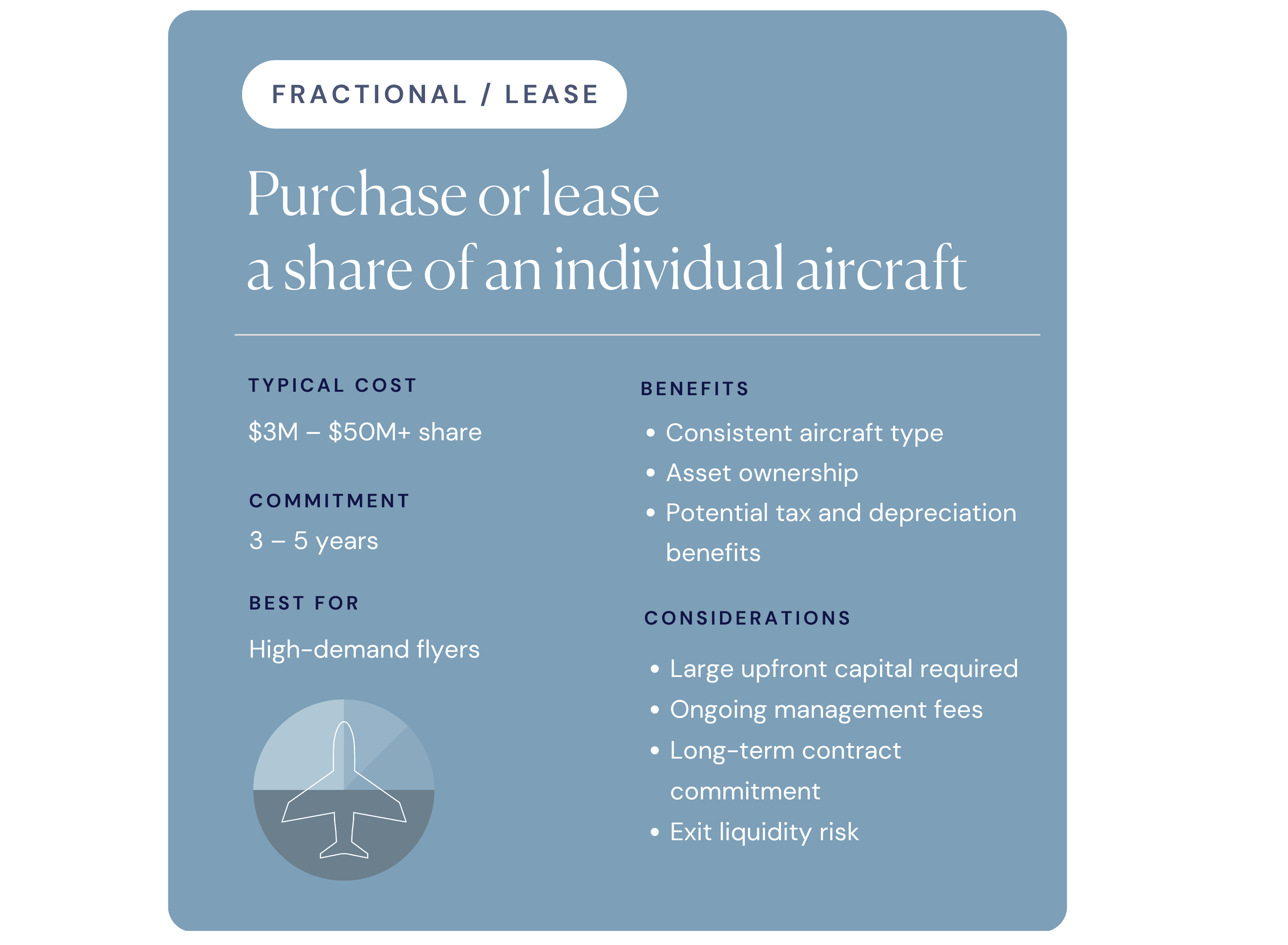
Owning an aircraft outright brings costs and complexities that don't suit every traveler. Fractional ownership offers many of the same benefits at a lower initial investment — you own a share of a specific aircraft, typically 1/16th or 1/8th, giving you guaranteed access to it or its fleet.
The share you purchase typically corresponds to an annual allocation of occupied flight hours. In addition to the acquisition price, owners generally pay a recurring management fee and an occupied hourly charge.
The true cost, however, is often underestimated. At the end of a typical five year term, the share is sold back to the program at a depreciated value, and the difference between purchase and resale price is a real cost, even where it is tax deductible. Add in monthly maintenance fees and occupied hourly rates, divided across your fraction's total hours, and the effective cost per hour climbs quickly.
Under U.S. rules, fractional programs operate within a specific regulatory framework under Federal Aviation Regulations Part 91 Subpart K. The model combines shared aircraft ownership, professional management, and agreements that make aircraft within the program available among participating owners. The National Business Aviation Association’s fractional ownership overview provides additional detail.

What Fractional Ownership Offers
- A formal ownership interest: The client holds title to a portion of an aircraft rather than purchasing transportation alone.
- A defined annual allocation: The share establishes a planned amount of flight time over the contract period.
- Fleet and service consistency: Programs generally offer standardized aircraft types, cabin experiences, operating procedures, and service levels.
- Potential tax considerations: Business aircraft ownership may qualify for certain deductions or depreciation treatment when applicable requirements are met. Tax outcomes depend heavily on ownership structure and aircraft use and should be evaluated with qualified legal and tax advisors.
Considerations:
- High capital outlay and long term commitment: A fractional share can require a substantial upfront investment, which may not be feasible for everyone. Fractional agreements also carry a long term commitment, typically several years.
- Operating costs: In addition to the initial investment, fractional owners are responsible for ongoing monthly and annual operating costs, including maintenance, crew salaries, and insurance. You may also be responsible for fuel costs (subject to fluctuation).
- Limited trip flexibility: Your choice of aircraft is typically limited to the fleet owned by the fractional ownership program, reducing your ability to match the cabin size to each trip. A short hop and a coast to coast flight with a full cabin call for different aircraft, and a single fleet type cannot always serve both efficiently.
- Contract duration: Fractional agreements are typically multiyear commitments, with specific provisions governing renewal, early exit, and resale.
One common misconception is that a fractional owner will always fly on the specific aircraft in the purchase agreement. In practice, fractional programs commonly use an interchangeable fleet. The tail number and crew may vary according to aircraft location, maintenance, scheduling, and availability.
How Should a Private Flyer Choose?
Flight hours may frame the conversation, but they rarely settle it. The better question is how you travel: where you go, who comes along, and how much certainty you want before departure.
Consider:
- Are your destinations and travel dates consistent or always changing?
- Will the same aircraft suit most trips, or do your passenger and range requirements vary?
- How important is access during holidays, peak periods, or on short notice?
- Do you prefer a predictable hourly rate or the freedom to shop the charter market?
- Are you comfortable committing funds or capital to future travel?
- Does aircraft ownership support a broader financial, operational, or tax objective?
- How easily should your program adapt as your travel needs change?
For those who fly more regularly, a Jet Card can bring greater consistency to pricing and access. Fractional ownership introduces a more structured, long-term relationship with a managed fleet.
And there is no requirement to choose just one. Many seasoned private flyers combine them, using ownership for parts of their travel, a Jet Card for dependable supplemental access, and charter when the journey calls for something different. If you are unsure where to start, the Jets.com FAQ covers the most common questions, or you can speak with a Private Aviation Expert.

Frequently Asked Questions
When does on demand charter make more sense than a Jet Card?
Charter usually makes sense for travelers who fly privately a few times a year, whose trips are hard to predict, or who want to experience private aviation before committing funds to a program. Once travel becomes regular enough that price and availability certainty matter, a Jet Card typically becomes the better fit.
Is a Jet Card the same as chartering a private jet?
Not quite. On-demand charter is arranged and priced one trip at a time. A Jet Card allows you to prepay for future travel under a defined pricing and service structure, bringing greater consistency to the charter experience.
Is fractional ownership less expensive than a Jet Card?
It depends on how you fly. Fractional ownership includes an acquisition cost, ongoing management fees, and hourly charges, while a Jet Card requires prepaid hours or funds without purchasing an aircraft interest. The most useful comparison considers the total cost over time, not just the quoted hourly rate.
Do fractional owners always fly on the same aircraft?
Usually not. Although the owner purchases an interest in a specific aircraft, most large fractional programs fulfill trips using an interchangeable fleet of the same or a comparable aircraft type. Crews may vary as well.
Which option provides the most flexibility?
It depends on what “flexibility” means. Jet Cards can provide more predictable access and pricing. Fractional ownership can provide a high level of program consistency and contracted availability, but within a more structured, long-term arrangement. The right fit is ultimately the one that most naturally reflects the way you travel.
News and Updates
The Sunset Report
Stay up-to-date on the latest news from Jets.com.

The Best East Coast Escapes for Fall 2026

Introducing the New Jets.com Safety Board